

The 18 Pillars
(A Timeless Strategy for Character, Leadership, and Wholeness)
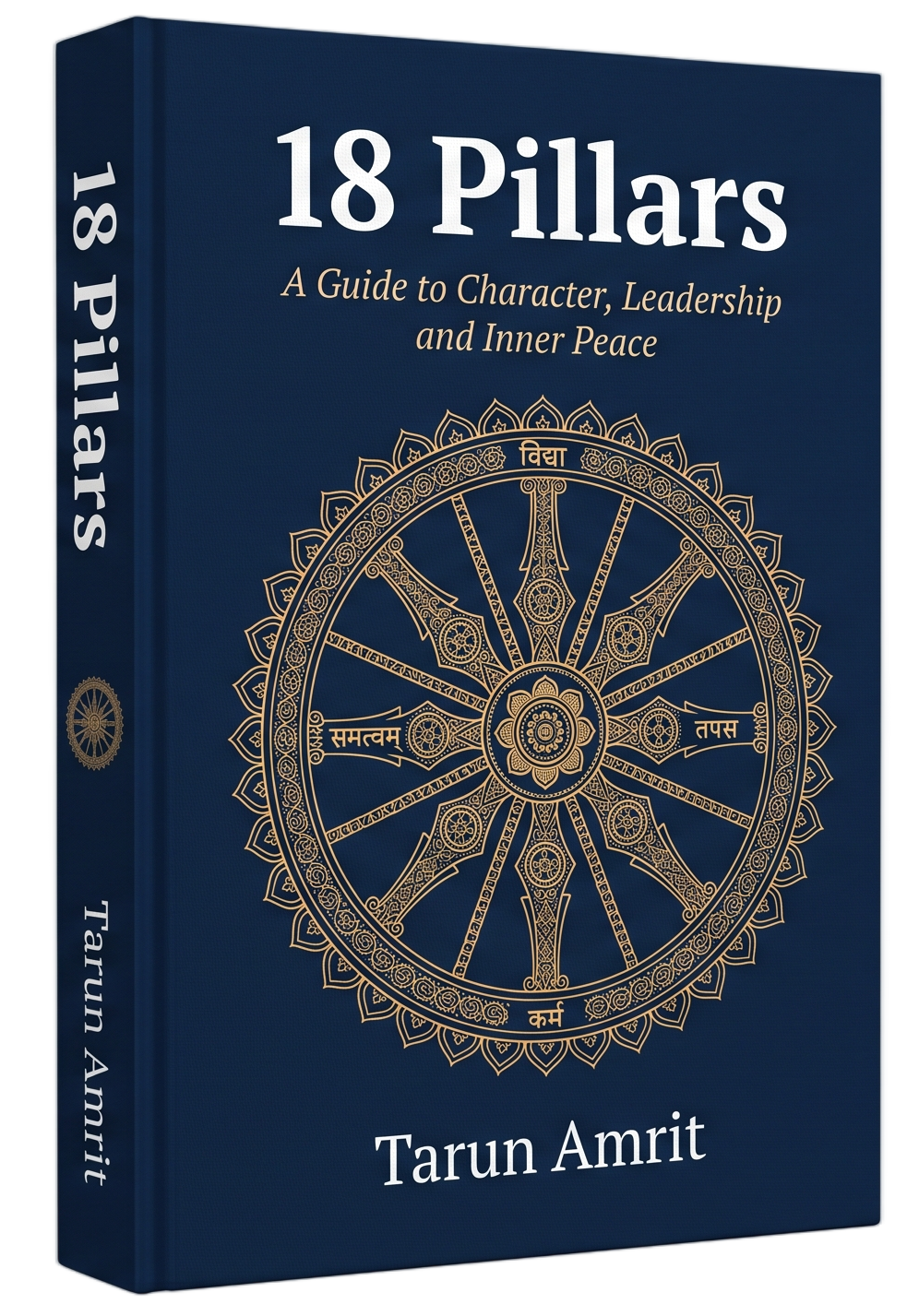
Contents:
Book overview
Why was it written
Foreword author
Endorsements
Sample chapter
Purchase links (Sooooooon)
Foreword author
“What he is offering is not a system. It is a map of the interior territory that every serious human life must cross.” — Nilesh Nilkanth Oak, Independent Scholar, Archaeoastronomy & Vedic Chronology | Author, When Did the Mahabharata War Happen?
Book overview
Drawing on the Bhagavad Gita, the Upanishads, and the Mahabharata — and tested against 27 years of service across the Indian Navy and ITBP — The 18 Pillars is a leadership book written not from a library but from the field. Anchored by the ITBP Ganga Expedition 2015 (2,350 km, 72 days, Golden Book of World Records), it offers eighteen Sanskrit principles as a complete architecture for character, leadership, and a purposeful life. Written for India’s youth — UPSC aspirants, NDA cadets, JNV alumni, and anyone standing at the threshold of eighteen, wondering whether the path ahead asks more than they have to give.
27 Years. 18 Lessons. One Book.
“Hi Readers,
The 18 Pillars is my most ambitious and personal project yet — and perhaps the most honest thing I have ever written.
Over 27 years of service, first in the Indian Navy sailing to Mozambique and the Maldives, then in ITBP leading battalions of twelve hundred men through the dense forests of LWE districts and the silence of the Sino-Indian border, I collected something no rank or medal could quantify: lessons. Lessons about why some people crumble under pressure and others quietly become unbreakable. About why integrity is infrastructure, not an event. About why the young officer, who knows who he is, will always outlast the one, who only knows what he does.
This book is my attempt to hand those lessons to you — directly, through story, before life charges you the full price for them.
Each of the eighteen chapters is named after a Sanskrit principle, not because Sanskrit is ancient, but because some truths are precise enough to deserve their own word. From the courage of the first step to the quiet completeness of a life fully lived — these pillars won’t build your character for you. But they will show you where they were hiding and how to find them.
The secret of words is for each and every individual who is waiting and ready to grow — not just upward, but inward.
FOREWORD BY

Nilesh Nilkanth Oak
Independent Scholar | Archaeoastronomy & Vedic Chronology Author — When Did the Mahabharata War Happen?

Nilesh Nilkanth Oak spent fifteen years decoding astronomical references in the Mahabharata, establishing a scientifically rigorous dating for
the events of the great war. His foreword to The 18 Pillars places the book within the living tradition of Indian civilisational scholarship —
as a work that restores the moral and characterological integrity of that tradition, not merely its historical record.
Endorsements
The 18 Pillars honours what residential schools quietly build in children — discipline, dignity, and the courage to begin. Tarun writes not as an observer but as one who has lived these truths across twenty-seven years of national service, and in doing so, he has given voice to what we in education have always known: that education’s deepest purpose is not a score — it is a character. As someone who spent a lifetime in that work, I recognise every truth in these pages. A thoughtful, grounded, and genuinely inspiring work for the generation we have spent our lives serving.
— Ms Kalavathi
Retired Deputy Commissioner, Kendriya Vidyalaya Sangathan
“I am proud to see Tarun’s new venture — The 18 Pillars — a work of genuine discipline and spiritual depth. Drawing on the values of our Vedas and Gurukul tradition, and grounded in his remarkable river-rafting expedition from Gangotri to Gangasagar — perhaps a world record — this book speaks volumes of his perseverance and commitment to a principled life. His columns on education and Naxalism had already established his range; The 18 Pillars reflects his deepest effort yet. I am confident the young generation will imbibe valuable values from this well-articulated and enriching work.”
— R.C.Baijwan
Retd Inspector General, ITBP
Tarun has brilliantly authored this treatise on holistic contemporary combat strategy, deeply imbibed from the timeless wisdom of our ancient scriptures. Have personally seen him outperform as a scholar warrior. He has amply lived and validated every principle of ‘The 18 pillars’ with his dedicated service during his illustrious uniformed journey across the complete spectrum over three decades. A must- read.
— Maj Gen Deepak Saini, Veteran, Indian Army
“The 18 Pillars brings timeless Indian wisdom into living practice. Written by an officer who has tested life in some of its harshest terrains, the book blends character, discipline and inner clarity with rare authenticity. A meaningful read for every young aspirant seeking not just success, but purpose. In an age crowded with motivational noise, this book speaks with the quiet authority of lived experience. It does not merely instruct; it prepares the reader for life, leadership and self-mastery.”
—Kamlesh Kamal, Dy Commandant, ITBP, Author, Operation Bastar Recipient, Vishnu Prabhakar Samman 2023
“Shri Tarun Banjaree, an ex-Navy and ITBP officer, has very successfully shared his personal experiences, highlighting the core principles of leadership, linking them with the wisdom of our scriptures. His innovative thinking offers food for thought for our youth, as well as serving and retired officers. One can be proud of the leadership principles enunciated in our ancient literature and emulate them in day-to-day work to become a better leader. My best wishes to the author for this commendable work — The 18 Pillars.”
— H.R. Singh Retd Additional Director General, CRPF
“Leadership” and Security Forces share a symbiotic relationship. The book encapsulates a rich, mature and nuanced narration of the essence of Leadership and its perennial pertinence.
— Major General Ajay Kumar Vig (Retd)
Why was it written
This book was not written in a library. It was written in a border post at fourteen thousand feet, in the back of a convoy moving through a Naxal-affected forest, in a tent beside the Ganga at Garhmukteshwar, and — in its final form — at a desk in Bhilai, in the quiet that followed twenty-seven years of service.
Before I tell you why I wrote this book, I owe you an honest account of who wrote it. In April 1997, weeks after walking out of a JNV hostel in Dongargarh, I sat for the Matric Entry Recruit Examination, MER-2/97 and cleared it. On 29 July 1997, I joined the Indian Navy not as a commissioned officer but as a Sailor — part of the Golden Jubilee Batch — and learned what institutional discipline feels like from the inside rather than from the top. While in service, I completed my graduation through IGNOU. I then prepared for and cleared the UPSC examination during active naval duty, entering the ITBP through the first-ever UPSC-selected batch for the Central Paramilitary Forces. Over the next two decades, I earned three Master’s degrees not during desk postings, but during the same years in which I commanded companies in Naxal-affected jungles, managed elections across multiple states, and led a sixty-member team on a 2,350-kilometre river expedition.
There was no family connection, no direct commission, no inherited advantage. There was a government residential school that believed in a boy from a small town before the boy had given it any reason to, and there were eighteen pillars — though I did not call them that then — that turned out to be the only reliable architecture for the life that followed.
This book is written for the person standing where I once stood.
Why I Wrote This Book
Somewhere between a patrol on the Sino-Indian border and a counselling session in a JNV, I understood something no course at the ITBP Academy or Army War College had made explicit: the greatest challenge any leader faces is not the enemy across the border. It is the undisciplined, unexamined self within. Over the years, I have watched officers of exceptional intelligence fail because their character could not sustain the weight of their ambition. I have also watched young men and women from the humblest backgrounds rise to national importance because they chose, day by day, to build themselves on principles that did not bend.
I began writing these pages as a practitioner, not a theorist. Every principle here has been tested in conference rooms and Sand Model Rooms where the cost of a wrong decision was measured in something other than money, in relationships that required the full weight of integrity, and in moments of failure that demanded more than resilience. The principles are not mine. They belong to a civilisation that has been thinking about these questions for three thousand years. What I have tried to do is translate that wisdom into the language of a life actually lived — with the Bhagavad Gita in one hand and an operational map in the other.
A few chapters draw on the archaeoastronomical research of Nilesh Nilkanth Oak, whose work places the Mahabharata War at 5561 BCE through analysis of over two hundred astronomical references in the text. I cite his work not as a convenient authority but because I believe it is correct — and because a book about intellectual honesty would be poorly served by intellectual evasion on its very first page.
This book is built on the conviction that character precedes leadership, and that who you are determines what you build, what you sustain, and what you leave behind. It is a letter written across two lifetimes, offered now to those who stand at the beginning of theirs.
— The Author
- Sample chapter
- Purchase links (when available)