

Why Do School Toilets Stink While Airport Bathrooms Don’t?

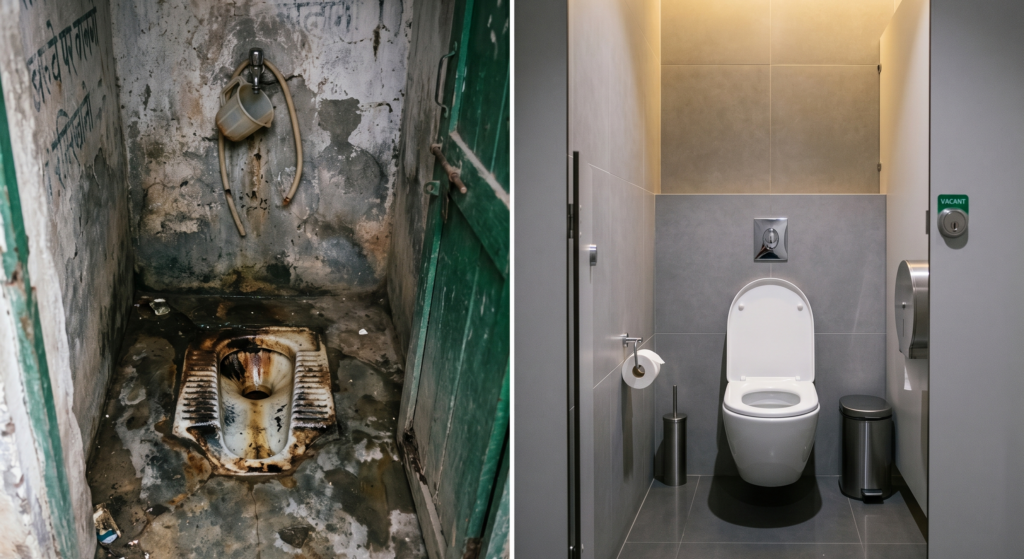
In a striking contradiction that reveals much about India’s infrastructure priorities, airport bathrooms remain fresh and hygienic despite heavy usage, while school toilets across the country are plagued by persistent foul odors that drive students away from facilities they desperately need.
This disparity isn’t accidental—it reflects systematic engineering and maintenance differences that are entirely correctable, according to a comprehensive analysis by Tarun Kumar Banjaree, an retired Gazetted officer of the Indo-Tibetan Border Police.
The Science Behind the Stench
The problem begins with chemistry. Fresh urine is mostly water, but when it evaporates from floors and surfaces, remaining compounds concentrate, intensifying odor. Bacteria then colonize these residues, breaking down urea into ammonia and hydrogen sulfide—creating the distinctively foul smell that makes school bathrooms unbearable. In porous surfaces like traditional grout, bacteria find ideal breeding grounds. As they multiply, the odor becomes nearly impossible to eliminate, often leaving surfaces permanently damaged.
The Critical Difference: Drainage Design
The fundamental distinction lies in drainage systems. School urinals typically feature exposed drainage channels where urine flows visibly along open surfaces before entering pipes—maximizing atmospheric exposure, evaporation, and bacterial growth.
Premium facilities at airports and shopping malls employ enclosed drainage systems. Urine enters sealed piping immediately after leaving the urinal fixture, virtually eliminating atmospheric exposure that accelerates odor formation.
“Schools should retrofit existing urinals with fully enclosed drainage where urine enters piping immediately after leaving the urinal bowl, minimizing atmospheric exposure,” Banjaree emphasizes in his research.
The P-Trap Problem
Another critical component often missing or malfunctioning in schools is the P-trap—a curved section of pipe containing water that prevents sewer gases from escaping into buildings. Many school installations lack properly maintained P-traps or have improper drainage that allows dangerous sewer gases to escape.
Airports and malls maintain these systems meticulously, creating water seals that work seamlessly with ventilation systems to balance air pressure and prevent odor migration.
Ventilation: The Overlooked Essential
Poor ventilation compounds the problem. Lacking mechanical exhaust systems, many school toilets rely only on small windows—often kept closed for privacy or security. Stale air builds up, moisture accumulates, and odors concentrate and intensify.
Premium facilities incorporate sophisticated exhaust systems that continuously remove odor-laden air and moisture, maintaining fresh environments even under heavy usage.
The Maintenance Mandate
Maintenance protocols reveal another stark contrast. Airports and malls employ professional staff with specialized training, multiple daily cleaning cycles, bio-enzymatic cleaners targeting urine compounds, and automated monitoring systems for supply replenishment.
Schools face crushing resource constraints. A Delhi study found that clean toilets and regular water supply are luxuries many schools cannot provide daily. This creates a vicious cycle: inadequate cleaning enables bacterial buildup that becomes progressively harder to remediate.
The Human Cost
The consequences extend far beyond unpleasant odors. Research shows eight in ten children report cleanliness issues in school toilets. One in five students in India miss school to avoid using facilities, while forty percent of teenagers deliberately avoid school bathrooms they find dirty or smelly.
Students restrict water and food intake to avoid bathroom use, causing lower urinary tract dysfunction with lifelong implications. The psychological burden—particularly for girls facing safety concerns—adds another layer of distress.
Nearly twenty percent of students cannot concentrate in class due to physical discomfort from avoiding restrooms. This directly undermines educational achievement and student well-being.
Solutions Within Reach
The good news: these problems are entirely addressable. Implementing enclosed drainage systems, ensuring proper P-trap installation, installing mechanical ventilation (minimum 6-8 air changes hourly), and establishing bio-enzymatic cleaning protocols would transform school sanitation.
A phased approach beginning with low-cost interventions—inspecting existing P-traps, establishing daily bio-enzymatic cleaning, and improving ventilation—can yield immediate improvements while longer-term infrastructure upgrades are planned.
“The engineering principles are well-established, the economic case is compelling, and the moral imperative is clear,” Banjaree concludes. “What remains is collective will to prioritize student sanitation as fundamental to educational infrastructure.” School children deserve bathrooms that support their health, dignity, and learning. The technology exists. The solutions are scalable. What’s needed now is commitment from policymakers, school administrators, and communities to make it happen.